

If you’ve ever typed “is it just me or is summer always this slow?” into the Yoga Studio Owners Facebook group, you’re not alone, and you don’t have to wait for the replies to feel better. Your own numbers can tell you the same thing, faster.
Four people showed up to your 6am class this morning. Your most popular teacher is on vacation, and you still haven’t figured out who’s covering Thursday’s 6pm slow flow. You’re interviewing a new teacher at 2 and your son’s day camp ends at 3. Summer doesn’t slow down for yoga studio owners, even when it slows down for their studios. So when September shows up, it doesn’t always feel like a fresh start. It might be the first chance you’ve had in months to take a step back and look at your business instead of just running the day to day.
Here are six places to look before the fall rush and then the holidays. If you’re newer to running a studio and the thought of year-end taxes is already sitting in the back of your mind, this checklist gets ahead of it instead of leaving you to scramble in January.
Here’s what you’ll check:
- Your summer numbers, and what last September and October can tell you
- Locking in your fall and winter schedule, intro offer, and Black Friday plan
- Your website, booking system, and studio space through a first-timer’s eyes
- Client retention and who’s quietly drifted away
- The back-office loose ends: tools, renewal dates, and what’s happening around you
- And one more thing: check on your own bandwidth as a business owner.
Pull your summer numbers
Before you plan anything, look at your numbers. Pull your bookings, package and membership sales, the ratio of drop-ins to recurring clients, and your cancellation rate for July and August.
The real question is which of these dropped, and why. Is it the summer, is it your marketing, or is it the class itself? A few quick ways to tell:
- Seasonal dip: a slow Tuesday evening class that usually picks back up once people are back from summer travel
- Real decline: a class that’s been dropping regardless of the season, a sign it’s stopped working and needs to be replaced with something else
- Demand problem: inquiries have basically stopped, which is usually just the season
- Friction problem: people ask about the class and then don’t show up, which means something between the inquiry and the mat is broken, and it has nothing to do with July
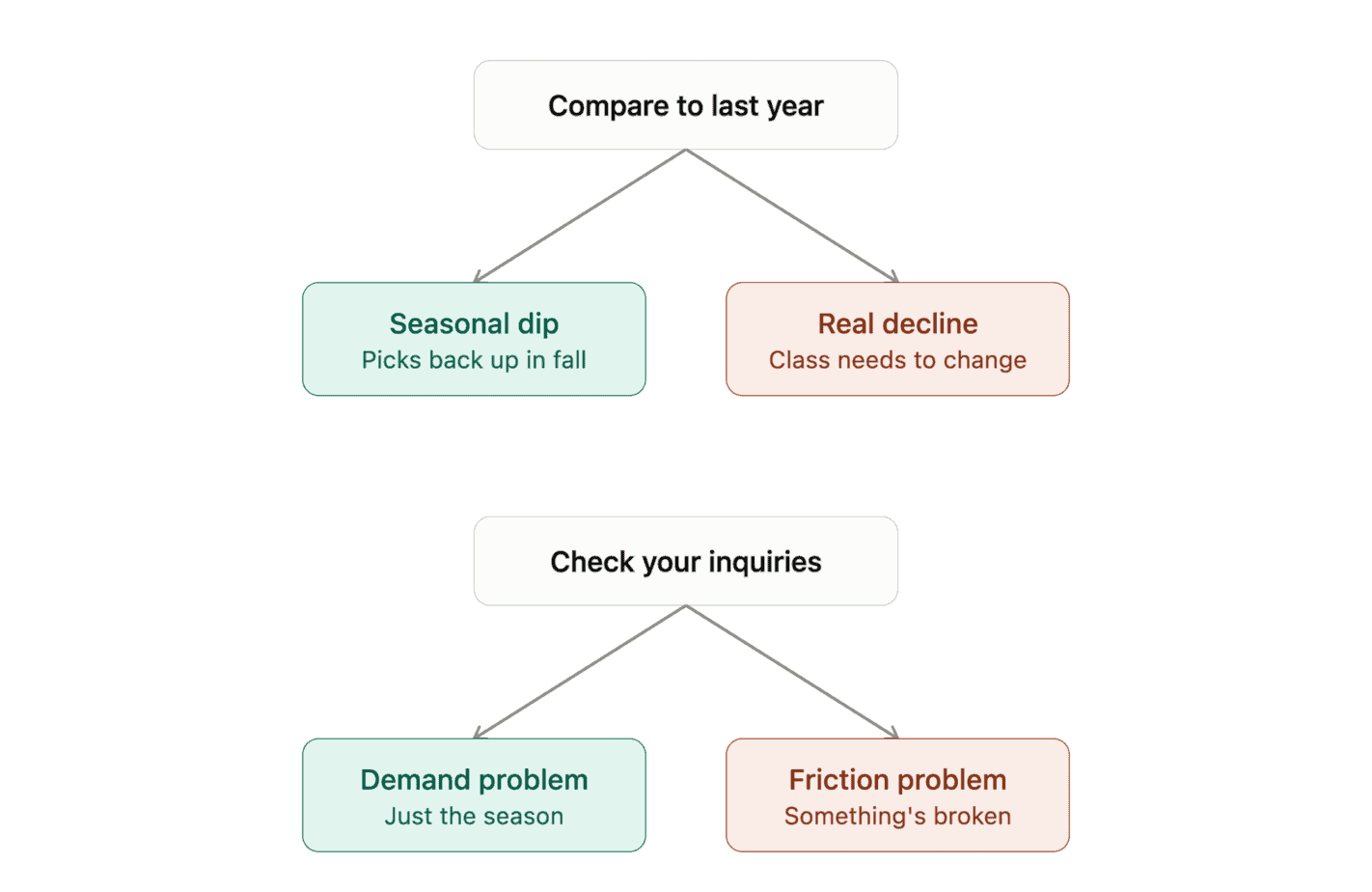
These situations call for completely different responses, and the only way to tell them apart is to actually look at the data.
While you’re in there, pull last September and October too:
- What filled up fast?
- What sat half-empty?
- Did a promotion flop, or did a schedule gap send people to a competitor for a few weeks before they came back, if they came back at all?
Last fall is a better benchmark than any generic industry number, because it’s your studio, your clients, and your market. If you’re an OfferingTree user, this is where Ask Sprout can save you the spreadsheet work. Instead of exporting reports and building your own comparison, you can ask a plain-language question like “how much revenue did I make in July and August compared to last year?” or “which classes have the highest fill rate this summer?” and get an answer without digging through anything.
Ask one focused question at a time, then drill in with a follow-up like “now break that down by offering type.” Run your summer numbers through it before you move to the next step.
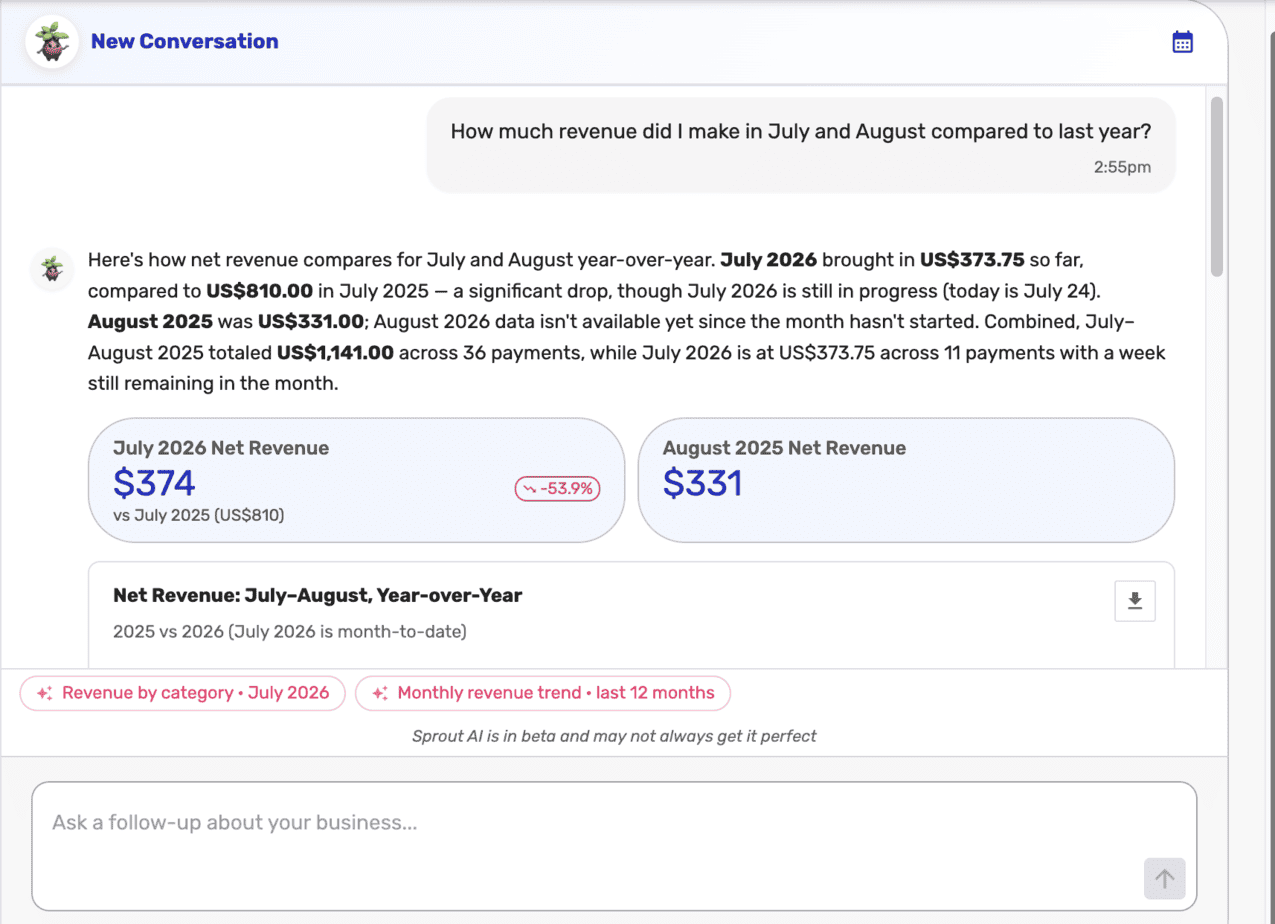
Screenshot from OfferingTree’s Ask Sprout feature in a test account.
Lock in your fall and winter offer
Once you know what happened, it’s time to lock in what’s next. This is the part that’s easy to keep putting off, waiting for a teacher to come back from leave or to see if that new class idea pans out before you commit to anything. September doesn’t wait for that clarity, so make the call now.
Finalize your fall and winter schedule. September and January are considered “rush periods” for the fitness industry. People are looking for structure again, so it’s a good time to make sure your schedule is updated and ready to convert new clients.
Review your intro offer. Is it still priced right? Is it still the right entry point for who’s walking in this time of year, or does it need a refresh alongside your new schedule? This is also the moment to start sketching your Black Friday plan. You don’t need it finished today, but deciding now whether you’re running a package deal, a gift card promotion, or nothing at all saves you from scrambling in November.
If you want to skip writing the campaign from scratch, OfferingTree’s Intro Offer Kit has the emails, social posts, and texts already written, along with a menu of offer options and a follow-up sequence to turn a first visit into a paying client.
Audit your client-facing systems
Once your schedule and offer are locked in, look at the systems clients actually interact with, the same eye you’d use on a first-time visitor to your studio:
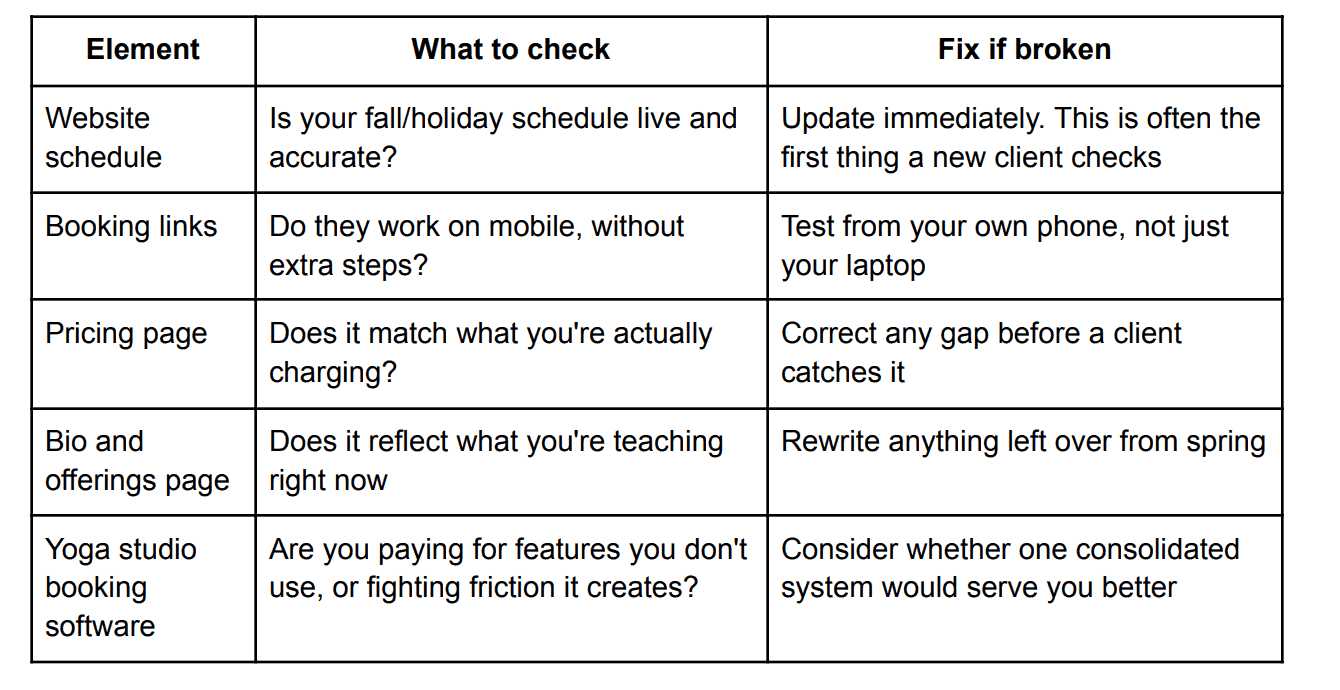
Then walk the studio itself. Check your props, mats, and cleaning supplies, and replace anything that’s worn out before fall traffic picks back up. It might seem small, but a client’s first impression of your space is still part of your marketing.
If you’re managing your website, scheduling, and payments across several different subscriptions, this audit is a good moment to notice how much of your week goes to stitching them together. OfferingTree keeps all three in one place, which is part of why studio owners use it to run this exact kind of check without opening five different tabs.
Check in on client retention
“How are my clients doing?” is too vague to act on. Make it specific instead.
Who hasn’t rebooked since May? Whose package is about to expire without a renewal conversation? Who used to come every week and quietly stopped showing up? Pull that list and treat it as your actual to-do item for this section.
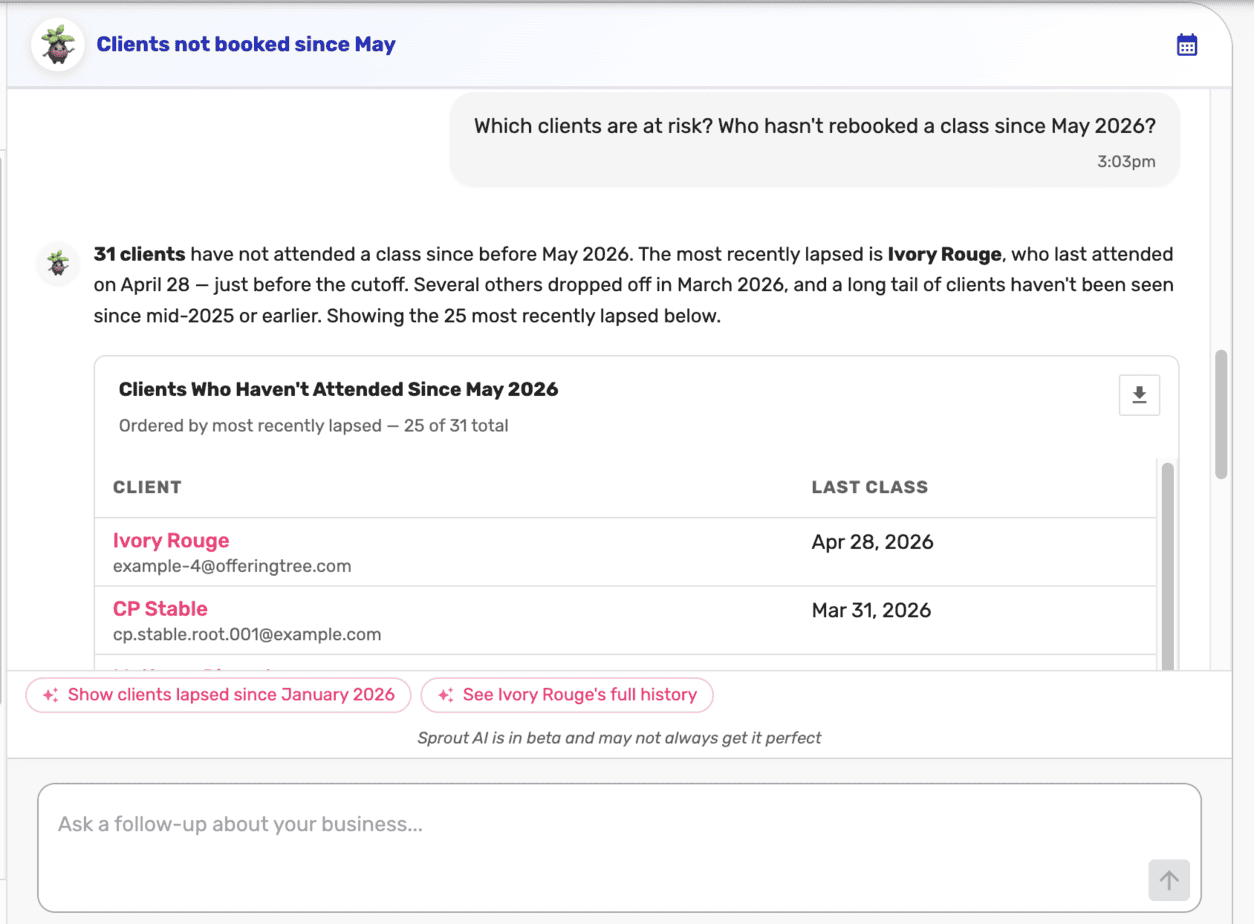
For anyone who’s drifted, a short, personal outreach works better than a blanket email. A few automation triggers make this easier to catch before it becomes a pattern:
- The 30-day inactivity trigger. A client who used to come weekly hasn’t booked in a month. An automation flags it and sends a simple check-in the day the 30-day mark hits.
- The membership-expiration trigger. A client’s package is down to their last session with no renewal booked. An automated nudge goes out a few days before it runs out, while they’re still actively coming in.
- The no-show recovery trigger. A client no-shows for the first time in months. Set up a same-day follow-up before it becomes a habit.
None of these require remembering to check manually. The system catches the moment, and the studio owner just has to write the message once. Something as simple as “we haven’t seen you in a few weeks, is everything okay?” opens a conversation instead of asking for a sale.
For more retention strategies beyond outreach, OfferingTree’s guide to client retention covers a few more angles worth trying.
The back-office loose ends
None of this is glamorous, but it’s the stuff that turns into an actual emergency in December if it sits untouched until then.
Look at any AI tools or subscriptions you’ve picked up this year. This includes AI tools like ChatGPT or Claude, virtual meeting tools like Zoom, accounting tools like Quickbooks, and creative tools like Canva or Adobe. Are you actually using all of them, or paying for two or three that all create social media posts for you? With all the new apps launching recently, this is easy to do. Only keep the ones that have earned their spot.
When’s the last time you actually looked at your insurance renewal date? Write it down, along with anything you’ll need to gather for taxes this quarter. Have this ready before you sit down with your accountant, so the beginning of the year doesn’t turn into a paperwork emergency.
Last, take a quick look at what other studios in your area or online are doing for fall. This is a sanity check on your own pricing and positioning, not a copy-paste exercise. If three studios nearby just dropped their intro offer price, that’s worth knowing before you finalize yours.
Your audit at a glance
- Pull this summer’s numbers, and last fall’s numbers for comparison
- Finalize your fall and winter schedule
- Review your intro offer and draft a basic
- Black Friday plan
- Audit your website, booking links, pricing page, and yoga studio booking software
- Walk the studio and replace worn props, mats, or supplies
- Pull your list of lapsed and about-to-expire clients and reach out
- Review AI tool subscriptions, insurance and tax renewal dates, and nearby competitor offers
This audit is what makes the end of the year manageable
That 6am class with four people in it? By the time you’ve run this audit, you’ll know whether it’s seasonal or something to replace, whether your schedule and offer are locked, and whether anyone’s actually reaching out to the clients who quietly stopped showing up.
This audit protects your time once the fall rush and the holidays hit, instead of leaving you to react to whatever comes at you.
One more thing belongs in this plan: after a summer of covering shifts, juggling childcare, and running your business without much of a break yourself, your own capacity matters too. A business that only works if you never stop isn’t sustainable, no matter how good your numbers look in September.
Run this audit now, while you still have room to make changes, and you’ll feel ready to tackle the last quarter of the year.
Frequently asked questions
When should a yoga studio do a yoga business audit? Early-to-mid September is the ideal window, once summer bookings have settled but before fall enrollment and holiday planning ramp up. It’s also, not coincidentally, the same time the fitness industry sees its second-biggest surge in new client interest after January.
What financial reports should a yoga teacher or studio owner pull quarterly? At minimum, booking and revenue totals, package and membership sales, cancellation rates, and a comparison against the same quarter the year before. Reviewing last fall’s numbers alongside this year’s is more useful than comparing against a general industry benchmark.
How do I know if a slow class is seasonal or a sign it’s not working anymore? Compare it to the same class and time slot from a year ago. If it dips in the same season every year and recovers on its own, it’s likely seasonal. If it’s been declining steadily regardless of time of year, the class itself may need to change.
Do I need to plan Black Friday now, in September? You don’t need a finished campaign, just a decision. Package deal, gift card promotion, or skipping it entirely, pick one now so you’re not building it from scratch in the last week of November.
Guest post by Katie Nissley
Katie Nissley is the Partnerships Coordinator at OfferingTree. She is also a certified personal trainer and yoga teacher who has spent her career at the intersection of movement, mindfulness, and mission-driven organizations. She began teaching yoga in 2015 and has worked in the nonprofit yoga world and wellness technology since. She writes for wellness professionals who want to lead with both heart and clarity.



0 Comments